
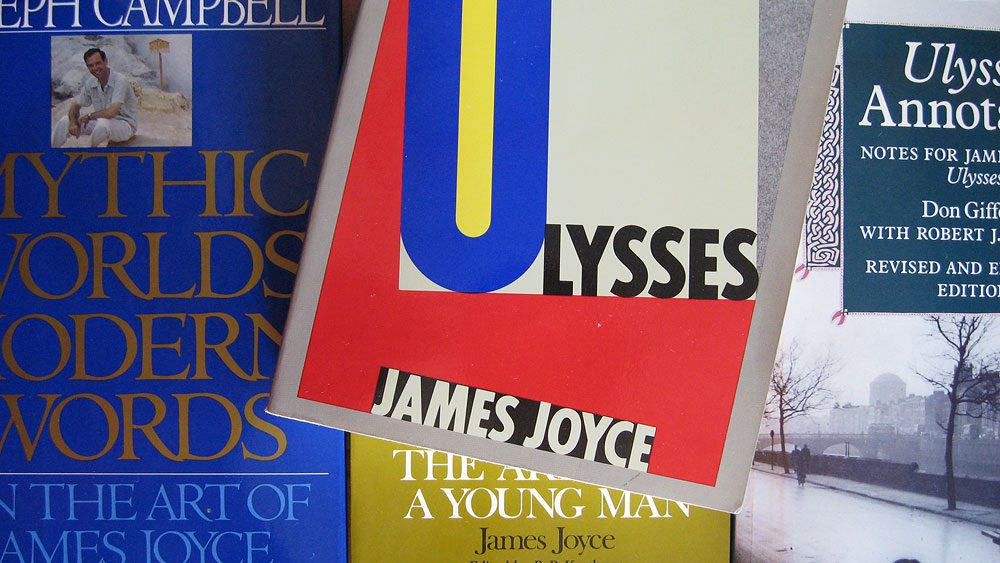
Bloomsday is coming up again this Tuesday, June 16, and so you might be hearing more about Ulysses and Irish writer James Joyce these days than you normally do.
Overnight, I caught Thursday’s episode of The Strand on the BBC World Service. During the program, host Mark Coles talked to Professor Declan Kiberd about Ulysses, sometimes called “the most unread literary masterpiece of all time.”
Kiberd has a new book of his own, called Ulysses and Us: The Art of Everyday Living.

Kiberd even thinks that Ulysses might well be the logical next step for smart 16 or 17-year-olds who have previously enjoyed 600-page Harry Potter tomes and complex video games.
For me, it was reading Joseph Campbell that brought me to James Joyce.
Anyone interested in tackling Joyce ought to look into Mythic Worlds, Modern Words. In it, Campbell explains that Joyce’s “master and model” was Dante Alighieri, and he shows how Joyce’s works echo Dante’s volume-by-volume:
Dante’s first work, the Vita Nuova, is a collection of poems with commentary that he wrote as a youth in praise of a named Beatrice Portinari. At the conclusion of the Vita Nuova, Dante says, “I now stop writing and go to prepare myself to write of her such a book as has never before been written of woman.” The book he wrote, recounting how the aspect of Beatrice wakened his inner eye and carried him finally to the very throne of God, was the Commedia, composed in three parts: Inferno, Purgatorio, and Paradiso. Joyce imitates Dante. Joyce’s first work, A Portrait of the Artist as a Young Man, is the equivalent of the Vita Nuova and imitates it in all of its basic themes. Then Joyce moves on to his own Divine Comedy, which was also to have been in three parts: Ulysses, as the Inferno; Finnegans Wake, as the Purgatorio; and the book Joyce did not live to write, as the Paradiso.
Another book which might be useful for the Ulysses reader is Joyce’s Dublin: A Walking Guide to Ulysses, by Jack McCarthy. It is a fine collection of maps, notes, and old photos of Dublin — the setting for the masterpiece, and as much a character in it as anyone else. Joyce is said to have boasted that if Dublin were ever destroyed in some catastrophe, it could be rebuilt — brick by brick — using Ulysses as a model. He wrote the book from a distance, reconstructing the city and the day of June 16, 1904 largely from clippings and records. For those like me who have never visited Dublin, this guide is a great help in picturing it in 1904.
Finally, an outstanding reference to read in tandem with Ulysses is Don Gifford’s ‘Ulysses’ Annotated. These rich notes are keyed, line by line, to Joyce’s text, and they shine a great deal of light on all sorts of references that Joyce makes — historical details, snatches of song lyrics, puns, place names, and on and on. Joyce’s writing is almost like hypertext, and this book virtually allows you to click on individual phrases and learn the deeper meaning as you read. Without this book, a lot of Ulysses might be incomprehensible. With it, you can better appreciate the layered allusion, analogy, and jokes which make it so rewarding to read.
Joseph Campbell also wrote A Skeleton Key to Finnegans Wake, and is said to have kept a copy of the Wake under one arm for years.
I have looked at the first page of Finnegans Wake, and it scares me.
Maybe someday.


0 Comments