

June 20, 2026, 9:14 p.m.: Somers, Wisconsin at dusk from Highways 31 and L.
Another Week: Number 182
Sunday was Donald J. Trump’s 80th birthday — and that afternoon, he announced the end of his war with Iran in a social media post: “The Deal with the Islamic Republic of Iran is now complete. Congratulations to all!”
But, clearly embarrassed, Trump kept the details of the “memorandum of understanding” to himself for several days. When those details began to emerge, even Republicans were stunned.
Trump launched his war with epic sound and fury — then found himself painted into a corner for three and a half months and finally threw in the towel. Basically, what he accomplished was the confirmation of Iran’s leverage at an enormous cost to the United States.
Donald J. Trump is an utter nincompoop. At a news conference on Wednesday, he admitted that the Iranians had him over a barrel economically, and he didn’t want to go down in history as another Herbert Hoover.
Trump cried uncle. He took our nation to war — then gave up on it out of concern for his personal image.
Meanwhile, in sports action, Caitlin Clark’s third season with the Indiana Fever is an interesting puzzle. Her stardom makes her a magnet for defenders, and her sour demeanor can gum up her team’s clockwork. I find myself recalling some wise advice from Nicky Childers on May 22:
An Open Letter To Caitlin Clark From A Black Woman Who Loves The WNBA
Clark had a bad shooting night on Tuesday, but guided the Fever to a 113-91 victory over the Toronto Tempo — aided by Sophie Cunningham’s six three-pointers.
On Thursday, during Indiana’s 108-101 loss to the Atlanta Dream, the Fever only seemed to gel in the fourth quarter with Clark on the bench in foul trouble.
Tuesday and Wednesday were rainy. On Wednesday, I turned my furnace on because it was 56 degrees outside. Thursday we were back to the 70s, and a hummingbird was scrounging my dryer vent for either lint or spider silk.
Saturday night there was another party across my backyard fence — this time with a little gunfire, and the cops came again to break it up.
I walked 3.38 miles this week.
![[divider]](https://markcz.com/wp-content/uploads/2022/12/divider-01.svg "divider-01")
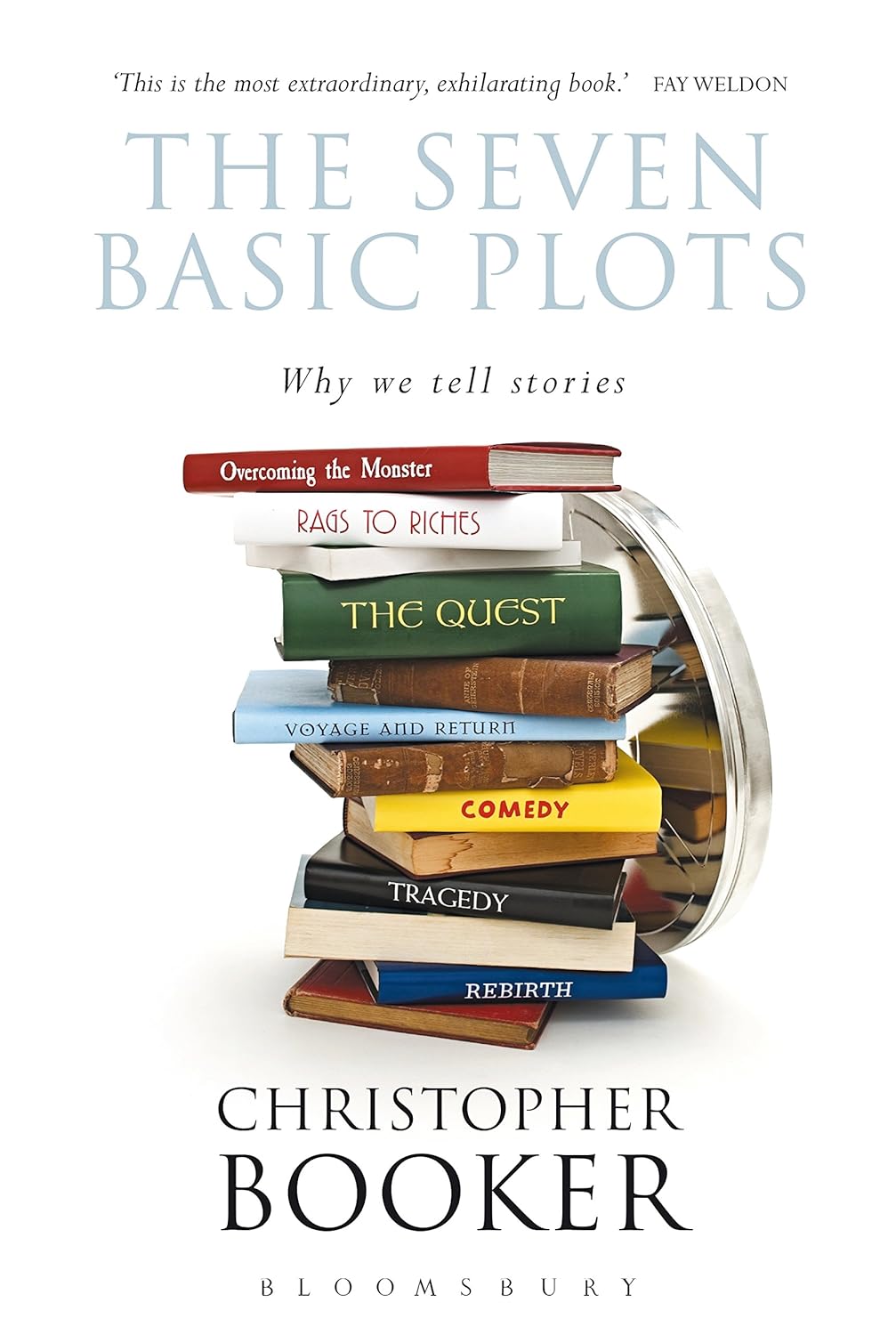
The Seven Basic Plots: Why We Tell Stories, by Christopher Booker
I have always been fascinated by the workings of stories, and when Joseph Campbell and The Power of Myth debuted on PBS in the summer of 1988, it confirmed for me that the same stories have been retold throughout human history in countless settings, starring heroes with “a thousand faces.”
This summer, after another 38 years of enjoying and studying stories, I read The Seven Basic Plots: Why We Tell Stories, by Christopher Booker. He spent 34 years writing the book before it was published in 2004.
This sucker was 734 pages long, and it was a bit of a slog because Booker uses many dozens of plots, from ancient history through Crocodile Dundee, as examples — and summarizes most of them in case you’re unfamiliar. The effect can be like hours of someone recounting their dreams to you. But the repetition helps him underline his points.
Also, although he begins with seven basic templates — “Overcoming the Monster,” “Rags to Riches,” “The Quest,” and so on — it soon emerges that some plots combine elements of two or three types, and others don’t really fit the mold at all, so “seven” begins to feel arbitrary.
Booker’s whole framework is basically just his interpretation of Carl Jung’s analytical psychology. He references Jungian concepts like “archetypes,” “the ego,” and “anima and animus,” and delves deeply into masculine and feminine attributes in both their light and dark aspects. He highlights how these elements play out to eventually arrive at a satisfying resolution. He also rails against stories that screw up the classic recipe, producing only frustration. For instance, he writes that “There is no growth in Chekhov’s characters, except that of foolish dreams and decay.”
According to Booker, the ultimate prize lurking behind any story is the realization of the “Self” — another Jungian concept to which he refers very frequently, but never actually explains, save for a cursory definition in the closing glossary.
One of my key takeaways from this book was that the next book I read should be a proper introduction to the thought of Carl Jung.
Christopher Booker (1937-2019) had a somewhat irregular career as a journalist and columnist — and he was a skeptic about global warming, the European Union, and the dangers of smoking.
Booker’s jarring views do encroach into his narratology. He goes on a long tangent about obscenity, violence, and the “degradation of the feminine.” He’s not necessarily wrong, but he certainly gets lurid.
He also applauds Margaret Thatcher for taking back the Falklands and supplying the “masculine resolve” that spurred George H.W. Bush’s Gulf War “against that archetypal ‘monster-figure’ and tyrant Saddam Hussein.” Bill Clinton, by contrast is “vain” and “promiscuous,” and Tony Blair is a “puer aeternus figure.”
Nevertheless, despite such grotesque quirks and the book’s rambling length, it is a helpful field guide for wandering mysterious landscape of stories, examining oodles of specimens along the way.
To Catch a Thief (1955)
The 1955 movie Summertime, set in Venice, was a huge hit with my mom, so on Tuesday evening we watched To Catch a Thief, Alfred Hitchcock’s 1955 romantic thriller set on the French Riviera.
The movie stars Cary Grant as a reformed cat burglar, and Grace Kelly as the daughter of a nouveau riche widow with dazzling jewelry. When a new series of burglaries makes him a suspect once again, he wants to prove his innocence using her gems as bait.
Cary Grant was 51 during filming and Grace Kelly was 25. He’s his charming old self and she’s an iconic beauty in a variety of stunning Edith Head costumes, but the age gap is too wide for romantic sparks to jump.
The plot is contrived and the outcome is predictable. The scenery is very nice — but it’s disturbing to watch Grace Kelly driving recklessly along the steep hills of the French Riviera where she suffered a cerebral hemorrhage and crashed in 1982, leading to her death.
To Catch a Thief has a 95 percent score on the Tomatometer — but I didn’t find much here to recommend.
Pennies From Heaven (1981)
My mom likes musicals, the Depression era, and Chicago. I’m not the biggest fan of Steve Martin, but Pennies From Heaven scored 83 percent on the Tomatometer, and Pauline Kael gushed that it was “the most emotional movie musical I’ve ever seen. It’s a stylized mythology of the Depression which uses the popular songs of the period as expressions of people’s deepest longings.”
We watched it Saturday night via Tubi and it was a huge disappointment.
The gimmick here is that the movie’s songs are vintage records from the period, and the characters lip-sync to them rather than singing themselves. The effect is odd but interesting — at least initially.
Steve Martin plays Arthur Parker, a struggling Chicago sheet-music salesman. His primary desires are, like any man’s, uninhibited sex and financial success. His wife has inherited some money, but she’s reluctant to let him use it to launch his own business. One day, out on a sales call, he meets Eileen Everson (Bernadette Peters), who radiates pure and sweet femininity. She is unmarried and, of course, a schoolteacher.
There are some promising elements here, but instead, the whole scenario steadily turns to shit. Martin plays his character like an idiotic cartoon — dumber, even, than his character in The Jerk. Peters is fine, but the plot debases her, and the whole mess ends in a big, ridiculous production number.
This was not time well spent.
0 Comments