
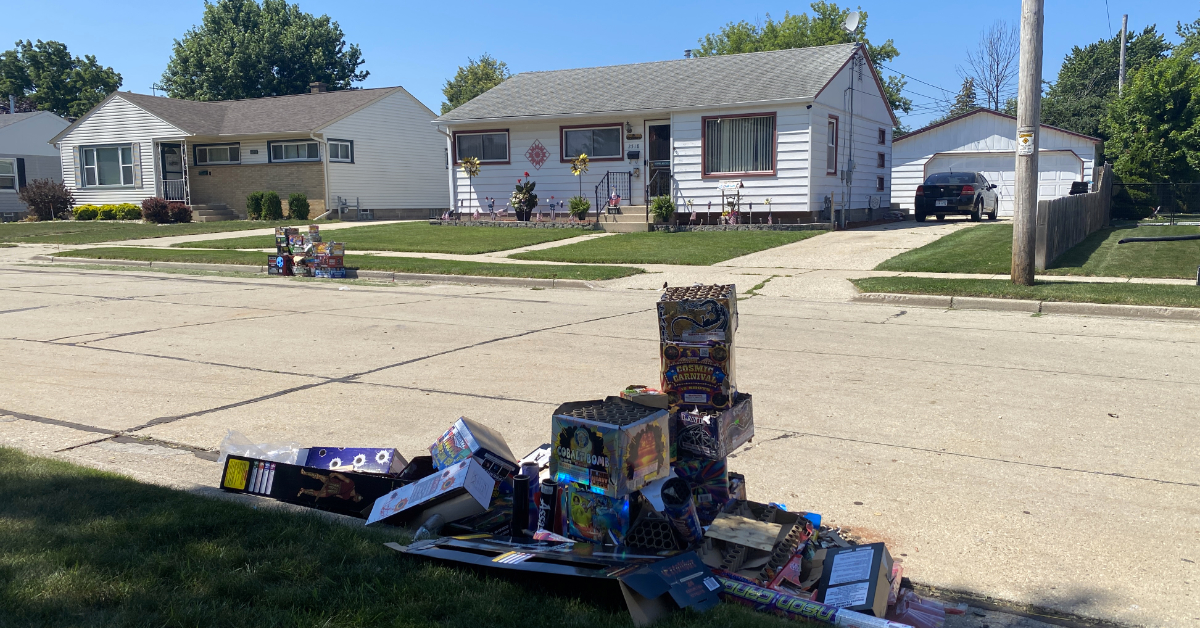
July 6 2026: July 4th fireworks refuse piled at the curb on Pinehurst Ave. in Racine, Wisconsin.
Another Week: Number 185
The USA’s 250th has come and gone. The 250th of what? Forty-six percent of Americans don’t know — but local residents blew off a shitload of fireworks nonetheless. On the federal level, Donald Trump’s legacy will be the fact that Gerald Ford threw a better party.
Our weather was beautiful on Monday and Friday. In between, I avoided the poor air quality and humidity by watching a number of Wimbledon tennis matches — and noticing out my window that my Purple Rooster bee balm bloomed with the perfect color and timing to complement The Championships.
When we first moved here, there was a Black Walnut nearby, and the squirrels used to run around carrying the yellow drupes precisely while ball kids were fetching yellow Wilsons at the U.S. Open. That tree is gone now — but the squirrels remain, year-round.
On Monday, a rape accusation slammed the door on Maine Democrats’ brief infatuation with Graham Platner for U.S. Senate.
Tuesday morning in Houston, a man named Lorenzo Salgado Araujo was shot and killed on his way to work by an ICE officer.
Wednesday, I turned 66., and celebrated by buying groceries and mowing the lawn. Meanwhile in Turkey, Donald Trump shitcanned his three-week old “deal” with Iran. I could not be sicker of hearing the word “deal.”
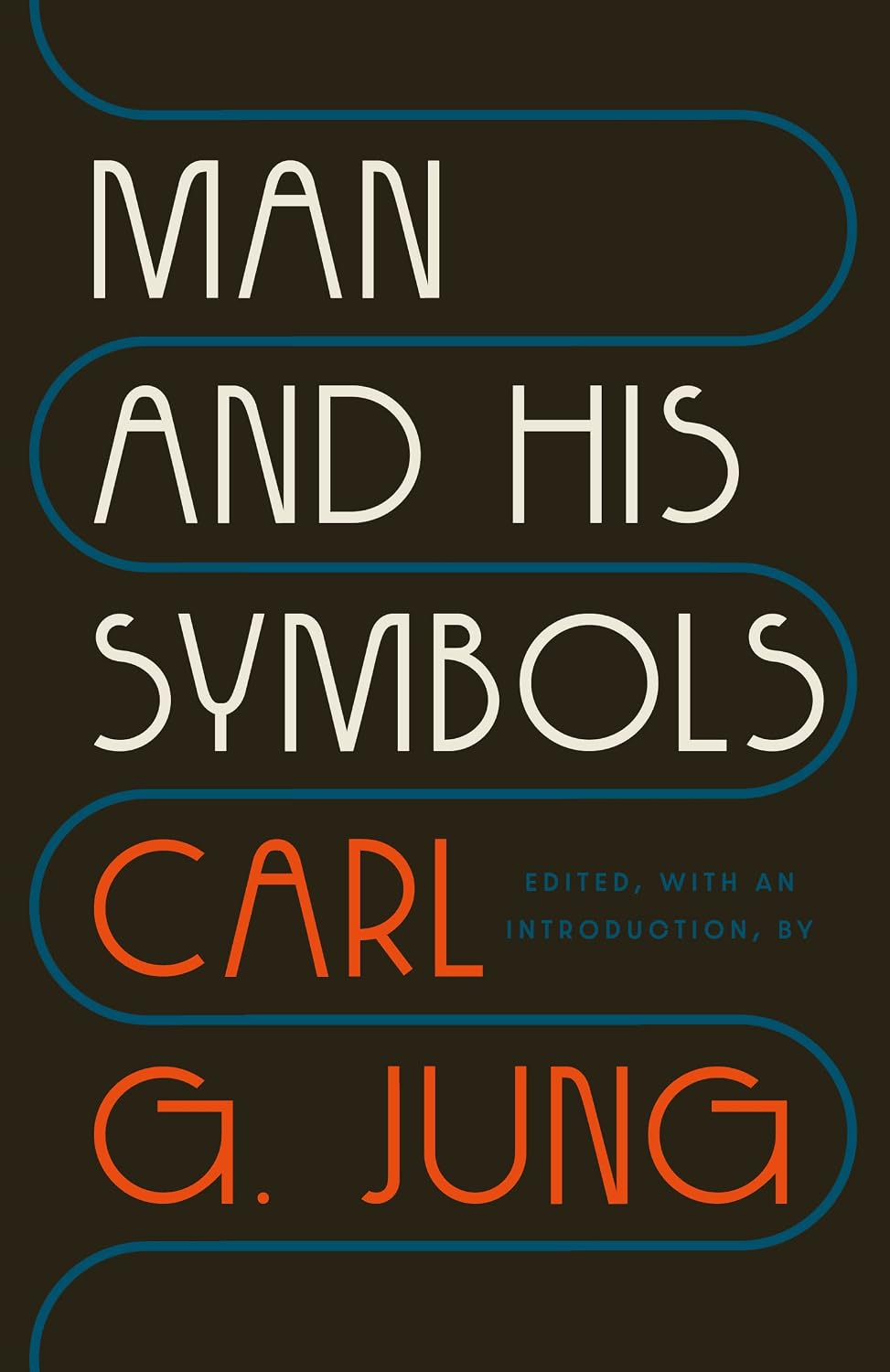
I have been reading Man and His Symbols as my introduction to Jungian analysis. On page 370, sacrificium intellectus was mentioned, and it struck me as the perfect explanation of Donald Trump’s sycophants.
On Saturday, a female robin was spread-eagled on my backyard lawn, apparently just relaxing, and watching the hummingbird sipping from my feeder.
I walked 6.64 miles this week.
![[divider]](https://markcz.com/wp-content/uploads/2022/12/divider-01.svg)
Man and His Symbols, by Carl Gustav Jung
Reading The Seven Basic Plots made me want to learn more about Jungian psychology. Man and His Symbols was written at the very end of Carl Jung’s life, specifically as an introduction to Jungian fundamentals for laypersons.
The book consists of five chapters — the first by Jung himself, and the others by four of his associates.
Jung introduces his concept of the “unconscious,” a vast, veiled portion of psyche that can communicate with our rational, everyday ego — especially through the symbolism of our dreams. He goes into this at length.
Joseph L. Henderson covers “Ancient Myths and Modern Man,” including hero myths, tricksters in Native American myths, initiation into a larger group, the meaning of “Beauty and the Beast,” Orpheus as a bridge between Dionysus and Christ, and so on. Having covered much of this ground reading Joseph Campbell earlier in life, I found it interesting, but not revelatory.
The chapter that really transfixed me was the third, by Marie-Louise von Franz, on “The Process of Individuation.” This is the establishment of a connection between our conscious and unconscious components, with the one listening to the hints and messages of the other.
Von Franz also expounds on the anima, “a personification of all feminine psychological tendencies in a man’s psyche, such as vague feelings and moods, prophetic hunches, receptiveness to the irrational, capacity for personal love, feeling for nature, and — last but not least — his relation to the unconscious.”
She explains the profound value available here:
Whenever a man’s logical mind is incapable of discerning facts that are hidden in his unconscious, the anima helps him to dig them out. Even more vital is the role that the anima plays in putting a man’s mind in tune with the right inner values and thereby opening the way into more profound inner depths. It is as if an inner “radio” becomes tuned to a certain wave length that excludes irrelevancies but allows the voice of the Great Man to be heard. In establishing this inner “radio” reception, the anima takes on the role of guide, or mediator, to the world within and to the Self.
(I can’t help but wonder whether Pete Hegseth might have better understood the Strait of Hormuz if he wasn’t so obsessed with stamping out anything he perceives as feminine.)
In the fourth chapter, Aniela Jaffé illustrates “Symbolism in the Visual Arts,” beginning with ancient stones — like Jacob’s dream of a ladder, and the stone used as his pillow which commemorated it — and Paleolithic cave paintings. She explains the symbolism of animals, and of the circle, elaborating into mandalas, one of Jung’s key insights, and squared circles. as well as more modern and metaphysical artists, such as Giorgio de Chirico.
Finally, Jolande Jacobi writes about “Symbols in an Individual Analysis” — a case study of “Henry,” a young engineer from a rural district in eastern Switzerland. She takes us into his childhood, his dreams, his romantic life, and his career goals, and the many symbols representing elements of all these interlocking aspects. It’s an illuminating trek.
For me, this book was an enormously helpful stepping stone. From a very early age, I have had a sense of some adjacent neighbor sending cryptic communications. A decade ago, I wrote about this as “Messages through the wall, heard on radio.”
Now, at age 66, thanks to the work of Carl Jung, I finally have a sketched floor plan of the rambling place where I live.
4 Little Girls (1997)
My mom has been receptive to films by Spike Lee, and somewhere recently I heard him mention 4 Little Girls, which I have never seen, so on Saturday night we streamed it via HBO Max.
The movie tells the story of the bombing of the 16th Street Baptist Church in Birmingham, Alabama on September 15, 1963 by local Ku Klux Klan members. Killed were Carol Denise McNair, age 11, Carole Robertson, 14, Cynthia Wesley, 14, and Addie Mae Collins, also 14.
It’s a fairly linear narrative, expertly woven, which takes you into the homes of these families as they remember the girls, the ordinary details of their last days, and the devastating grief caused by this vicious act.
The film’s incredible power flows from its matter-of-factness in unfolding these events. There’s no sentimentality, no attempt to underscore tragedy — just the living rooms and the faces of people who experienced stark evil in their hometown. Lee even lets aged George Wallace, Alabama's governor at the time, repeatedly tout his calls his Black personal assistant as one of his "best friends."
My mom said she thinks its important to learn about these things because not enough attention was paid at the time.
0 Comments