
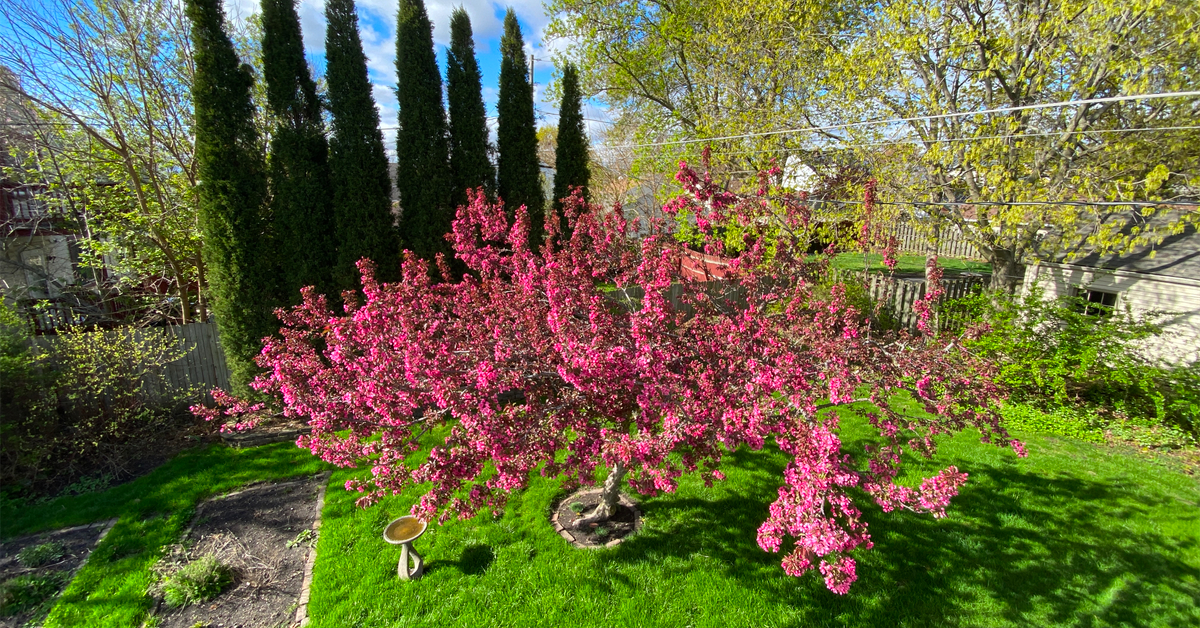
April 28, 2026: My backyard crabapple tree in bloom.
Another Week: Number 175
Progress these days comes little by little. I am slowly organizing decades of information on my laptop. I’m building and updating various websites. I’m following a diet plan and walking with some regularity. My lawn is mowed and most of the perennials I planted last year are coming back — but maybe not the lavenders. I read books and play guitar and sing every day. My sleep has been satisfying, my dreams mundane.
But it feels like I’m treading this path through the middle of a washing machine. The same arbitrary items keep tossing around.
I wake up and there’s still frost on the rooftops. The United States is in the middle of a stalled war against Iran — but now the administration and its Republican supporters are insisting the war is not a war, or that it’s paused or terminated or something. James Comey has been indicted again, this time for posting a photo of seashells on Instagram. Both Donald J. Trump and his wife again want Jimmy Kimmel fired for a routine joke he told. Trump’s ballroom mania has kicked into a whole new gear — with the project justified, somehow, by the apparent assassination attempt at the White House Correspondents’ Dinner.
King Charles spoke to a joint session of Congress and delivered a few subtle rebukes of Trump that will have no effect whatsoever. The U.S. Supreme Court gutted what was left of the Voting Rights Act, which is devastating to what’s left of our democracy.
Oh — and The Atlantic reported that Trump equates himself with figures like Alexander the Great, Julius Caesar, and Napoleon Bonaparte.
Who called it?
I walked 9.52 miles this week.
![[divider]](https://markcz.com/wp-content/uploads/2022/12/divider-01.svg)
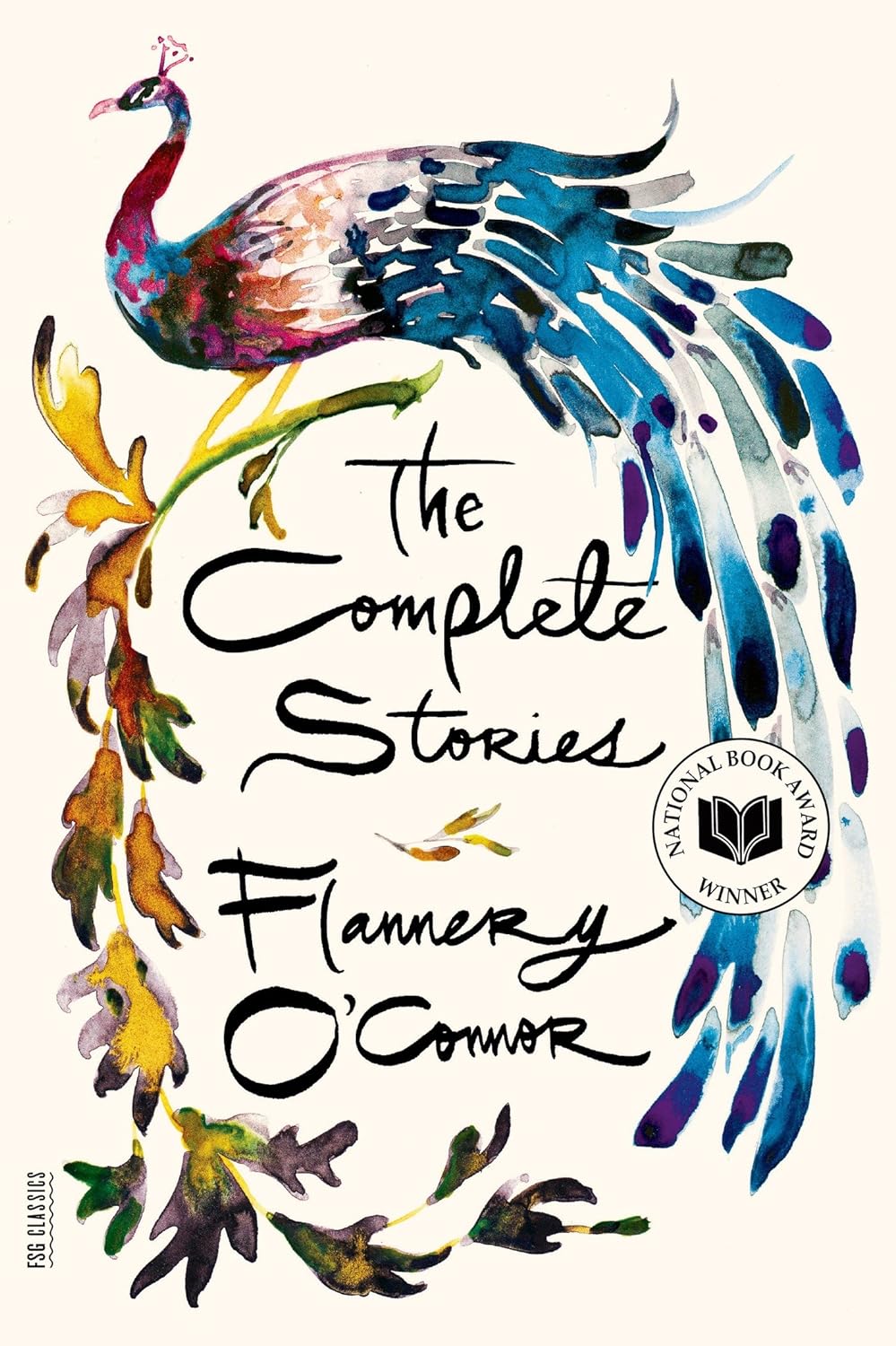
The Complete Stories, by Flannery O'Connor
Way back in the 1980s, Bruce Springsteen mentioned Flannery O’Connor, and I made a mental note to read her — but then some Southern Gothic family tree on the web recommended starting with William Faulkner, and I didn’t get around to him until a couple of years ago. Now I’m seven novels in, and it wasn’t bad advice.
More recently, the Warren Zanes book about Springsteen’s Nebraska album and the movie made from it both highlighted O’Connor’s stories as a key influence. Then I read Lucinda Williams’ memoir, and she described visiting O’Connor’s home as a young girl.
So okay — I finally bought and read The Complete Stories by Flannery O’Connor over the past three weeks. It was a harrowing delight.
First of all, Flannery O’Connor (1925-1964) lived most of her shortened life in Georgia. Her father died of lupus when she was 15. A decade later, she was afflicted by the same disease and spent much of her remaining time battling it on a farm with her mother.
Meanwhile, the Jim Crow South was in decline. The Civil Rights Act was passed and signed as O’Connor was dying. Her stories contain vicious racism and many instances of “the n-word.” She was reflecting the world she saw.
The 31 stories in this collection convey their author’s limited vista. Many of them take place on farms. The line of trees on the horizon is acknowledged constantly. Often there’s an older woman, plus a younger woman or girl with a round face. In one, the author takes us right inside the imagination of a girl who’s writing a story.
Physical disabilities are frequent elements, and questions of God and religion are folded in liberally. O’Connor was a Catholic in a region where this was heretical, and she’s frequently labeled a “Catholic writer” — but I didn’t sense her expounding dogma so much as confronting her maker about her mortality.
The characteristic most commonly associated with O’Connor’s writing is the “gothic” stuff, the brutal cruelty so plainly described that it makes your hair stand on end. There’s plenty of that in these stories — offset by her wonderful, wry humor. Again, I took it as the digestive process of an extremely thoughtful woman fated to die at age 39.
American Masters: Flannery
After reading her stories, I wanted to know more about Flannery O’Connor, so I purchased the 2019 documentary Flannery from Apple. It aired as an installment of PBS’s American Masters series in 2021.
The film is a straightforward biography that sketches out the main phases of O’Connor’s life and work. One thorny episode was the anti-communist clash at the Yaddo artist retreat in upstate New York. Another was O'Connor's refusal to meet James Baldwin in Georgia.
Among the commenters is Conan O’Brien — who is also Irish Catholic — and Sally Fitzgerald, who knew O’Connor well for many years. There’s also some helpful insight from writer Alice Walker, who grew up just down the road from O’Connor’s Andalusia Farm.
0 Comments