

July 22, 2026: Farmland in Somers, Wisconsin west of 72nd Ave.
Another Week: Number 187
Twenty weeks in, Donald J. Trump’s erratic war on Iran continues to meander aimlessly. After three more U.S. service members were killed last weekend, bringing the total to 18, Trump ordered airstrikes to “swiftly punish” Iran. On Tuesday, our Dippity-Do’d Defense Secretary Pete Hegseth asked Congress for a $1.5 trillion defense budget. Then, after repeated threats about hitting Pickaxe Mountain, the U.S. put its attacks “on a hold” on Friday night.
Meanwhile, Spain and France are on fire, and states from Minnesota to Maine are choking under wildfire smoke. The golden rain tree the city planted at my curb a couple years back finally withered and gave up.
Our local ten days of hell lifted on Tuesday morning. I turned the air conditioning off to enjoy the tropical breezes and the hummingbird working my salvias.
By Wednesday, I was wearing a sweatshirt, and the weather was cool enough to finally trim the shaggy yew shrubs in front of my house.
I also visited my mom at lunchtime, and she started recalling the 1955 Robert Mitchum movie, The Night of the Hunter, telling me in great detail about the film’s spooky direction, and its shots of wildlife on the riverside as the children flee Mitchum, so I found “The Making of The Night of the Hunter” on YouTube. We watched it together — and the interviewees echoed all the points she made to me.
My recent interest in Jungian psychology has produced some small but encouraging results. I have started remembering more of my dreams — and the notion of processing dark material from the unconscious into creative work in the waking world is intriguing.
I walked 3.41 miles this week.
![[divider]](https://markcz.com/wp-content/uploads/2022/12/divider-01.svg)
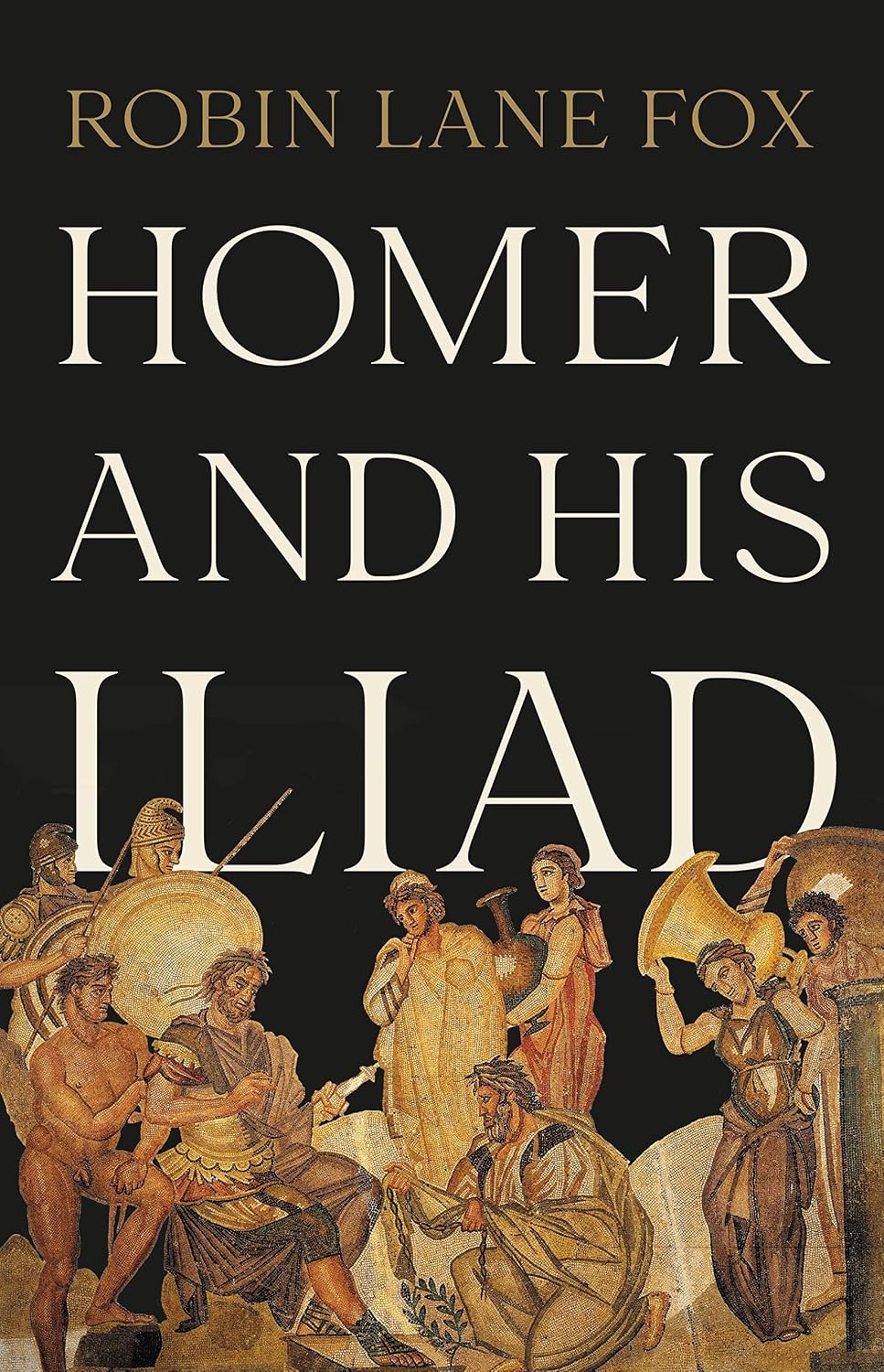
Homer and His Iliad, by Robin Lane Fox
This summer, thanks to Christopher Nolan’s movie, the Odyssey is a huge topic of conversation. I read the Robert Fagles translation with Amy, as well as James Joyce’s Ulysses, a couple of decades ago when I was working my way through Joseph Campbell’s work.
But I never tackled Homer’s previous tale, the Iliad.
I have read two books — Pagans and Christians and The Classical World — by English classicist and gardener Robin Lane Fox, and thoroughly enjoyed them. The Iliad is Lane Fox’s great joy in life, and he’s been teaching it for over half a century, so I thought I’d read his Homer and His Iliad before diving into Homer himself.
It’s a wonderful introduction. Lane Fox details the rhythms of the poem’s hexameter. He points out particular landscape features and flowers from the story that can still be found today. He lauds Homer’s cinematic scene interpolation, his micro/macro juxtapositions, his shifting tenses to bring speakers alive.
Especially interesting is Lane Fox’s hypothesis of the work’s development. He judges Homer to be an actual man performing the epic over several days, likely accompanying himself on a lyre for at least some opening verses — one superstar in a long tradition of oral poetry that also includes titles like the Epic of Manas, performed in the last century by Sayakbay Karalaev of Kyrgyzstan.
I couldn’t help but think of Bob Dylan’s sixteen-minute “Highlands,” or seventeen-minute “Murder Most Foul,” and the oral poets called rappers who have immense modern followings.
Homer’s own heyday happened to coincide with the development of the Greek alphabet, and Lane Fox supposes that the illiterate poet seized the opportunity to dictate his verses for preservation. He also suggests that the reader could easily learn Homeric Greek in just a couple of years to enjoy the Iliad in its native language, but I’m going to pass.
Robin Lane Fox is as well-versed on the Iliad as a person can be, and his admiration for the ancient masterpiece is, in itself, very moving. Having his comprehensive overview of the work and his highlighting of its exquisite details will greatly enhance my own appreciation.
Hamnet (2025)
On Thursday night at my mom’s, I selected Hamnet for us to watch, now that it had just been added to Netflix. The drama got a lot of Oscar buzz and Jessie Buckley won best actress. Mom has also been fairly receptive to Shakespeare-related stories lately, and she’s still grieving her daughter, so I thought it might click.
It was fine, but not as satisfying as I had hoped.
Buckley stars as Agnes, a young woman of Stratford-upon-Avon, the daughter of a local “witch” and raised in the outmoded ways of nature — such as herbal medicine, falconry, and palm-reading. One day, a young man named William Shakespeare (Paul Mescal), working nearby as a tutor, is transfixed by her, tells her the story of Orpheus and Eurydice, and off we go.
The main tension here — based in fact — is that her husband’s future as a playwright can only blossom in London, but Agnes stays in Stratford raising their children.
My disappointment lies mostly with the way William is written. He is more of a floundering husband than a canny analyst of the human condition. Before moving, he stays up late and turns to drink out of frustration with his writing. This poor, tortured soul shows absolutely no potential to become Shakespeare.
Hamnet’s Wiccan message is ham-handed, but the story does show life’s incredibly dark events being spun into gold through hard, artistic work, and the movie’s long, tearjerking culmination is good if not great. Combined with Max Richter’s score, and the sets and costumes, it adds up to a diversion worth watching.
Peter Asher on Fresh Air
On Saturday morning, while trimming, edging, and mowing my lawn ahead of returning hot and muggy weather, I listened to an episode of Fresh Air with Terry Gross and Tonya Mosley from July 7th featuring music producer Peter Asher.
I have heard about Peter Asher here and there over the years, but this interview showcased the totality of his career to promote the new documentary, Peter Asher: Everywhere Man.
Paul McCartney lived with Peter Asher’s family early on, and wrote Peter and Gordon’s No. 1 hit “A World Without Love.” Asher discovered James Taylor, and he launched Carole King’s recording career. Asher produced and managed Linda Ronstadt. As a child actor, he was in a film with Claudette Colbert and the TV series The Adventures Of Robin Hood. He co-owned the art gallery where John Lennon met Yoko Ono. He’s had a lifelong friendship with guitarist Danny Kortchmar. He’s the man who put backing musicians’ names on pop albums.
What a fun and exciting life.
Unhook the Stars (1996)
On Saturday night, after lots of web surfing and some kibitzing from Google Gemini, I watched Unhook the Stars with my mom.
It seemed like a great idea.
The 1996 family drama stars Gena Rowlands and Marisa Tomei. Rowlands plays a widow in Salt Lake City, and Tomei is rough-edged mom with and an abusive husband and 6-year-old-son who needs babysitting.
These are fine actresses. The notion of well-mannered Mildred helping to refine young J.J. with frequent references to the encyclopedia is adorable.
But then the plot branches off into several uncertain directions. Mildred accompanies Monica to a local bar where Mildred meets a truck driver played by Gérard Depardieu, of all people. Mildred’s son moves with his wife to San Francisco and invites Mildred to join them. Monica’s husband improves his behavior, so Mildred’s babysitting is no longer required.
I can’t tell you how this whole tangle resolves, because the movie up and leaves you hanging. I can guess — but why bother when director and co-writer Nick Cassavetes just abandons the whole story with barely a goodbye like a failed draft tossed in a wastebasket?
At least we only wasted and hour and 43 minutes.
0 Comments