
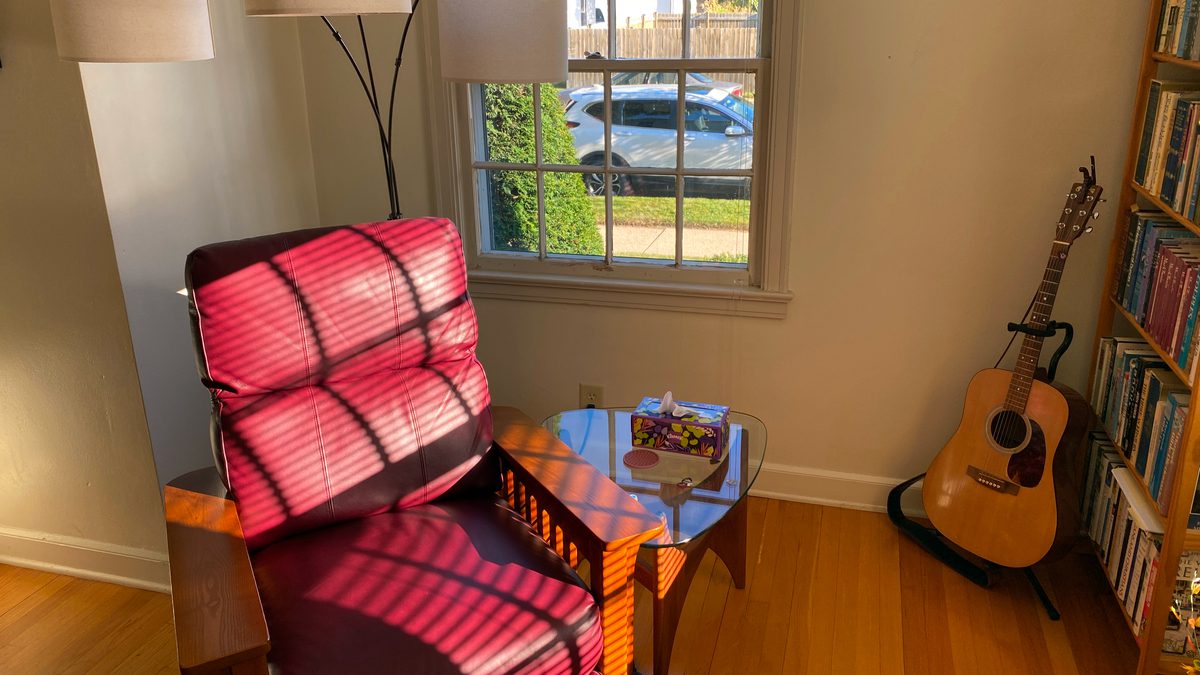
September 2, 2025: North end of the author's living room.
Another Week: Number 141
All summer long, while doing yard work, I've been tormented by a LeafFilter commercial on iTunes. In the ad, “Ron” falls off his ladder while calling in to speak with a LeafFilter expert.
Even as I cringed, my own gutters creaked overhead with three years of debris and some portion of my crumbling roof. I did not clean them in the autumn when Amy was dying, and I did not clean them the following year in my grief. She had been my gutting-cleaning partner for 18 years, carrying one end of the extension ladder while I carried the other, and generally spotting me from the ground while I clambored and scooped.
Our neighbor Waino also used to join in, crossing the street to stand below me and helpfully yell up that I should be careful not to fall.
Now both have passed on, and I'm alone with my two-story ladder, my stupid Wells Lamont Gripper gloves, and my plastic bucket.
Sunday afternoon — the day before Labor Day — was the perfect opportunity, with 71 degrees, light wind, and absolute peace and quiet. I clanked the cumbersome ladder up into place, climbed and cleared, then lowered it and moved to the next position. The back gutter took me about an hour. It was kind of fun.
Walking around to the front of the house, I heard the first tuba notes as I stared upward. My neighbors on the next block were kicking off another backyard party like their 4th of July bash — with, I'm guessing, the same live Banda band.
Pickup trucks were already starting to line the curbs, and the last thing I wanted to do was attract the attention of passing partygoers while wobbling above to a Norteño beat.
I let the front gutter wait until Monday, which also went well. The party pulsed on into the darkness, then politely hushed at midnight.
Tuesday was the first day in session for the newly remodeled Mitchell School across the way from me, and it looks like the parking congestion on my street has been reduced by more than half. The block feels lonelier. The bustle of the school day has always lent rhythm to my work-from-home solitude. That has diminished, and my favorite teacher has vanished.
The week was flecked with rain, but never much — except for a five-minute downpour on Wednesday. Temperatures turned colder than normal, and my furnace ignited for the first time this season on our 46-degree Thursday morning. Meanwhile, despite Donald Trump's promise to cut energy costs by half in his first twelve months, electricity prices are soaring.
The national news continues to spew a new outrage — or two or three — every day. On Wednesday, Florida announced it will get rid of all vaccine mandates. On Thursday, Robert F. Kennedy, Jr., the Trump administration's equivalent of Allstate's “Mayhem” guy, threw a Senate Finance Committee hearing into utter chaos. Meanwhile, Trump signed a proclamation renaming the Department of Defense to the Department of War. Now an insane number of signs, napkins, and jackets will have to be replaced, at a cost to taxpayers of over $1 billion.
To dodge the nauseating developments, I continue to watch sports — the Indiana Fever, some Chicago Cubs, and now the new NFL season. I am slowly coming to the opinion that sports should do away with video reviews entirely, because they smother all momentum multiple times in each game. Just have the officials make the call, live with it, and keep rolling.
My backyard hummingbirds have been gulping down nectar while I sit six feet away on the back step, eating an apple. There was a female American Redstart in my birdbath this week, flashing her yellow tail bars.
I walked 5.94 miles this week.
“‘I never said that,’ he says — and yet, he was clearly lying about that.”
![[divider]](https://markcz.com/wp-content/uploads/2022/12/divider-01.svg)
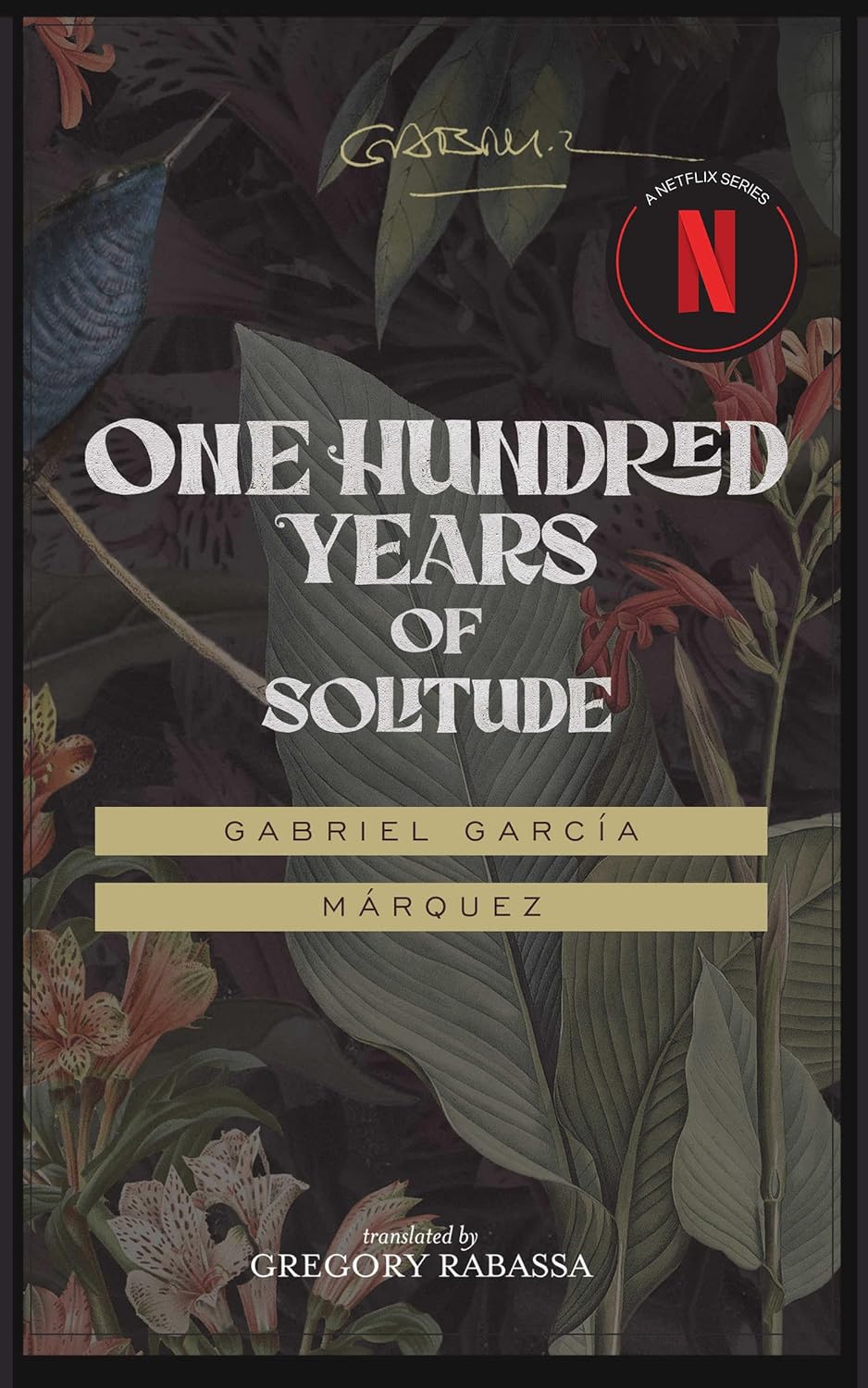
One Hundred Years of Solitude, by Gabriel García Márquez
It was back in July that I scanned my bookshelf and landed on a title that has been sitting there for at least two decades: One Hundred Years of Solitude, by Gabriel García Márquez. I tentatively took it out to the backyard a few times — then finally committed, by buying it again as a Kindle book so I can highlight and annotate without remorse.
The novel is the story of seven generations of the Buendía family in an isolated town in Colombia, from about the 1820s to the 1920s. García Márquez combines bits of history, plenty of family lore, improbable visitors from far-off lands, miscellaneous antique wonders, ghastly afflictions, and oscillating distant politics with extremely colorful characters in dwellings constantly cycling between neglect and rehabilitation.
For added fun, characters of each new generation are named after ancestors, so distinguishing them becomes difficult — and may not be entirely necessary.
I have always enjoyed a certain Latin sense of humor that maintains a straight face despite the most outlandish details. This book ladles that stuff out so richly that I had to pause for digestion every couple of pages. It's like reading jazz, with certain themes and scenes developing for a while, then morphing into something else. Now and then, García Márquez breaks into an extended solo, improvising into uncharted territory. He sprinkles variants of the word “solitude” into nearly every page. His descriptions of decay are exquisite.
Eventually, though, I began to feel slightly dissatisfied because no real plot was emerging. Just then, a chillingly serious plot surfaced and took my breath away — only to gradually dissolve into a fog.
The book is an absolute masterpiece — but the element that hit me hardest was the solemnity surrounding the way one of the characters studied and mastered the clavichord. I'm familiar with the harpsichord, but I had to consult YouTube to find out what a clavichord is. That laugh alone will last the rest of my life.
Describing the book to my mom, I mentioned that there's a recent Netflix version, and she thought we could watch it together. But no — it's 16 episodes of about an hour each, all in Spanish, and only half of them have been released so far.
A Raisin in the Sun (1961)
On Sunday night, my mom and I skimmed through her cloud DVR and landed on A Raisin in the Sun, the drama adapted from Lorraine Hansberry's 1959 Broadway play about a Black family living in a cramped Chicago apartment. Many of the cast members were brought in from the stage production, so they knew their roles well.
Claudia McNeil plays the matriarch, Lena Younger, who lives with her daughter Beneatha (Diana Sands), a medical student fashioning her African American identity, and her son, Walter Lee (Sidney Poitier), a chauffeur with a wife (Ruby Dee), and a son (Stephen Perry) who sleeps on the couch.
As the story begins, Mrs. Younger is expecting a $10,000 insurance check following the death of her husband, and there are various ways this money could be put to use. Moving the family to an actual house is one option. Funding Beneatha's education is another. And Walter would like to invest the money to open a liquor store with two buddies.
The play uses the money to stir up various passions. It triggers Walter into a battle for his masculinity, Ruth into desperate calculations about her family's future, and Beneatha into lofty ambitions. It also attracts the raw racism of the Clybourne Park Improvement Association via visits from its calculatingly polite spokesman (John Fiedler).
Overarching and juggling it all is the matronly wisdom of Lena, with whom my mom could readily relate.
A Raisin in the Sun is a thought-provoking diorama, an expertly written and acted conflict of universal human desires.
0 Comments